Apr 3, 2015

Calcutta ( Kolkata ) 1945: An American Military Photograph Album - Part 7

Part 1 | Part 2 | Part 3 | Part 4 | Part 5 | Part 6 | Part 7 | Part 8 | Part 9
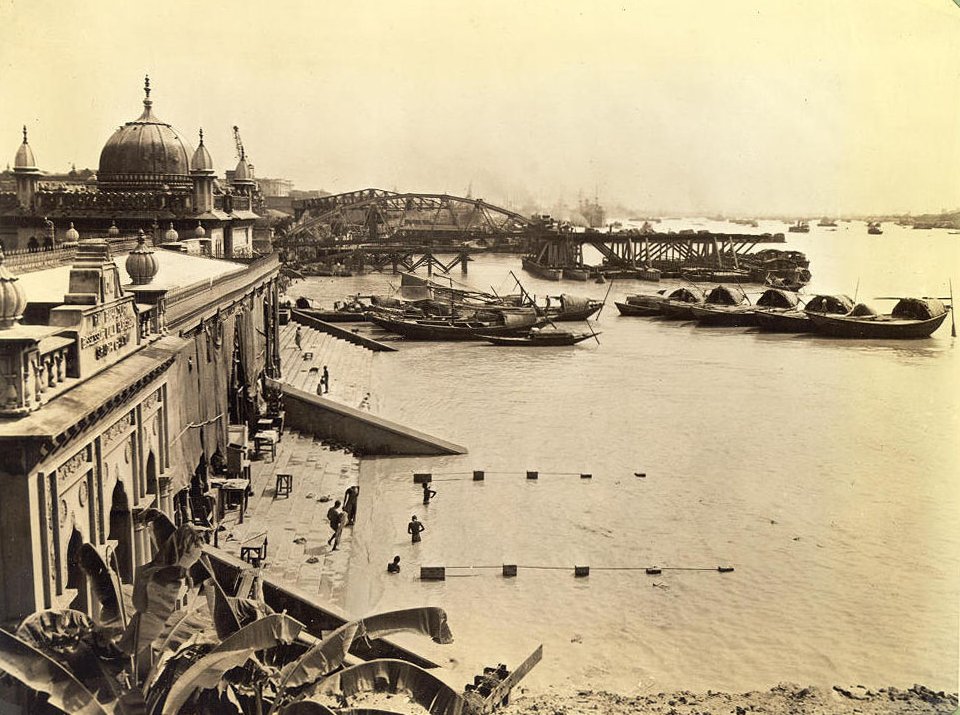
The Hooghly riverThe Hooghly river is lined with bathing ghats likke the one shown here. The troop transports in the background seem out of place in the old-world atmosphere created by the temple at left and the sampans at anchor.

Street scene outside the Calcutta stock exchangeStreet scene outside the Calcutta stock exchange. The noise is similar to the bedlam in all word exchange and many transactions (unofficial) take place in the street as shown here.

Calcutta Howrah BridgeCalcutta boasts the third largest cantielver bridge in the world. Its real importance, however, lies in the fact that it serves as Calcutta's gateway to the wese, being the city's only bridge spanning the Hooghly.Taking 7 years to build, it cost $10,000,000. It towers 310 feet as the city's highes structure, is 2,150 feet long with a center span of 1,500 feet. It was completed in 1942, opened in February, 1943.
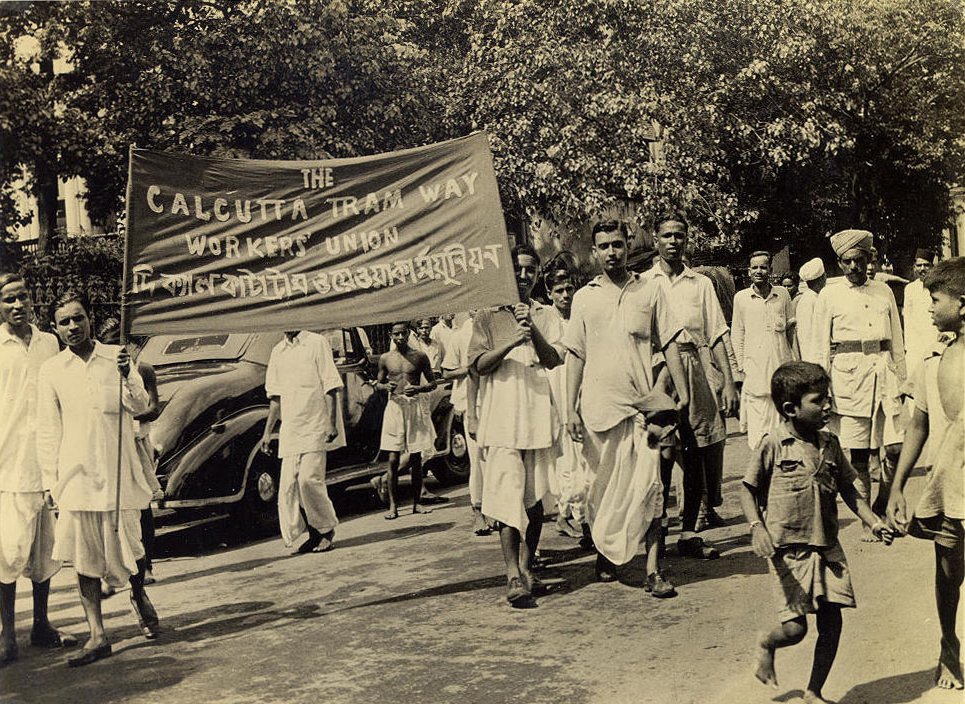
Calcutta Tramway Workers' UnionIndicative of the resumption of an age-old struggle for decent conditions is this immediate post-war picture of tram-workers on strike. The strike lasted nine days but employees won par of their demands.
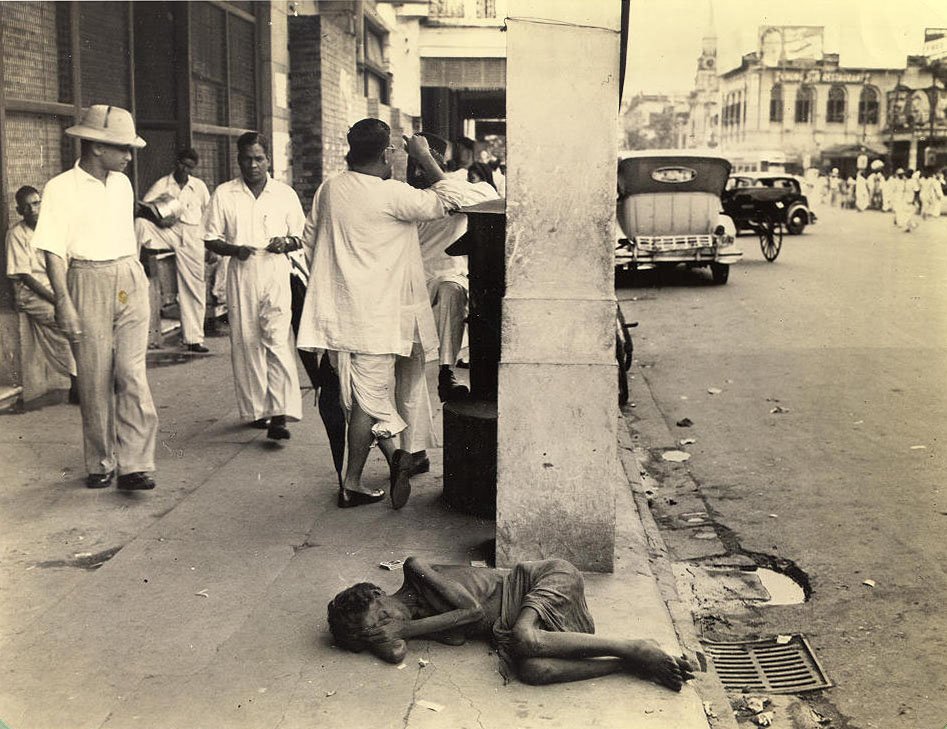
dying woman calcutta 1945The indifference of the passerby on this downtown Calcutta street to the plight of the dying woman in the foreground is considered common. During the famine of 1943, cases like this were to be seen in most every block, and though less frequent now, the hardened public reaction seems to have endured.

Calcutta ( Kolkata ) 1945: An American Military Photograph Album - Part 6

Part 1 | Part 2 | Part 3 | Part 4 | Part 5 | Part 6 | Part 7 | Part 8 | Part 9

Indian movie actresses
Indian movie actresses. Dressed in Sarees, 19-year old Binota Bose, left, and Mrs. Rekha Mullick, right, are right at home before the camera and lights. Miss Bose earns $360.00 per month and Mrs. Mullick $210.00. Both are well educated and prefer American books, pictures.

Young woman and child
India has thousands of child bries. The unfortunate young waman shown here feeding the infant from the giant coconat in foreground has been seen on Calcutta's streets day after day with he child. Her misery is more than typical thousands of India's unfortunates.

Palace in CalcuttaIn contrast to the magnificent palace in background, two sweating coolies strain at a load of precious firewood. The building is known as the Marble palace, contains a rich collections of paintings, lavishly furnished. it belongs to a Bengali family who are alleged to feed hundreds of poor daily.
Calcutta's poor peopleCalcutta's poor from a line to buy keresene at 6 a.m. Each little cubicle may contain a shop and living quarters for a family ranging possibly from 6 to 12. Sanitary facilities consist of an open street drain.

Indian women, dressed in the native SareeIndian women, dressed in the native Saree, return from prayer at Jain Temple. Little girls wear European dress usually until the marriage age, although some mothers like to dress the little girls in Sarees.

Calcutta ( Kolkata ) 1945: An American Military Photograph Album - Part 5

Part 1 | Part 2 | Part 3 | Part 4 | Part 5 | Part 6 | Part 7 | Part 8 | Part 9

The Nimtolla Mosque
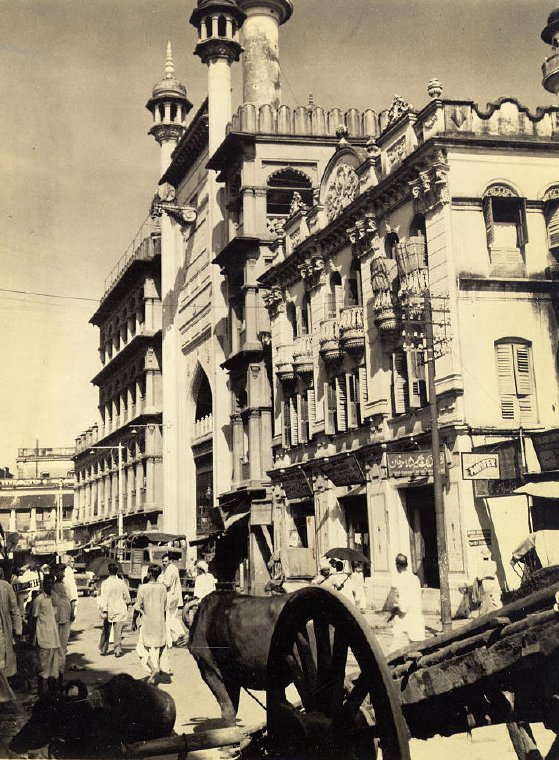
The Nimtolla Mosque, largest Mohammedan mosque in Calcutta. Its prayer hall will accomodate 10,000 worshippers. A modern specimen of Indo-Sarascenic architecture, its Minarets (towers)are 151 feet high. GI truck at entrace is waiting for a load of soldiers on American Red Cross tour.
Nimtolla burning ghatNimtolla burning ghat where Hindus burn the bodies of their dead and commit the remains to the Hooghly river. Several funeral pyres still burn while abandoned baby in foregroud awaits burning.

Hindus bathe in the holy water of a canalHindus bathe in the holy water of a canal which was cut from the original bed of the Ganges. Steps lead down from the grounds of the Kalighat temple. Water is still considered holy, even though from the Hooghly.

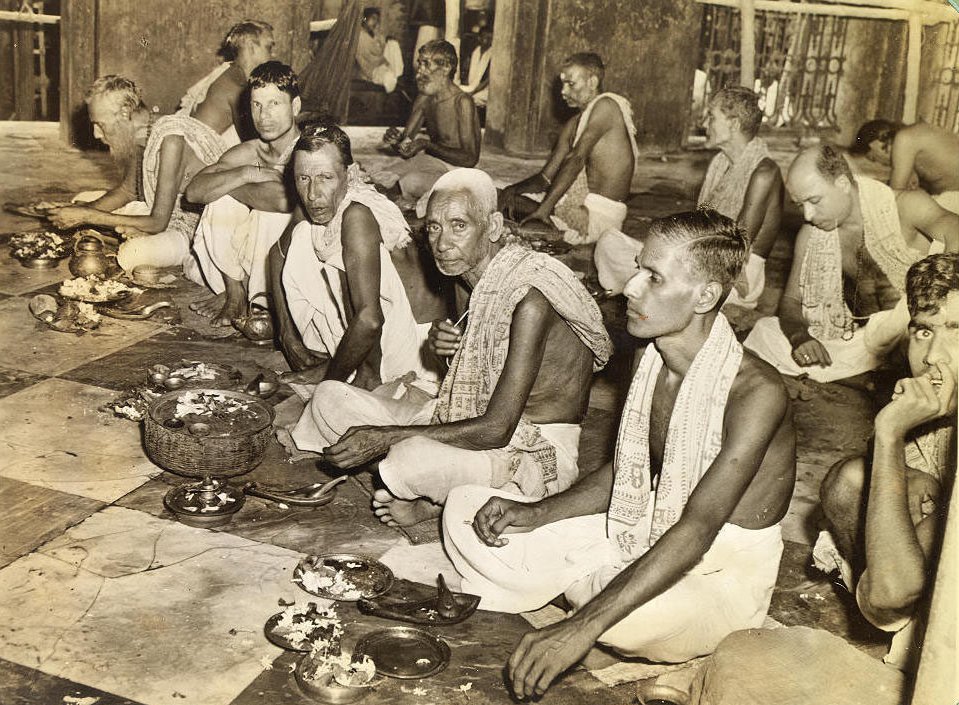
Brahmins worhips in the Kalighat templeBrahmins worhips in the Kalighat temple Spoon-shaped brass container holds Ganges waer. Brahmins are the highest caste of Hindus, their mark of distinction being the piece of string seen in hand of gray-haired senior Brahmin.

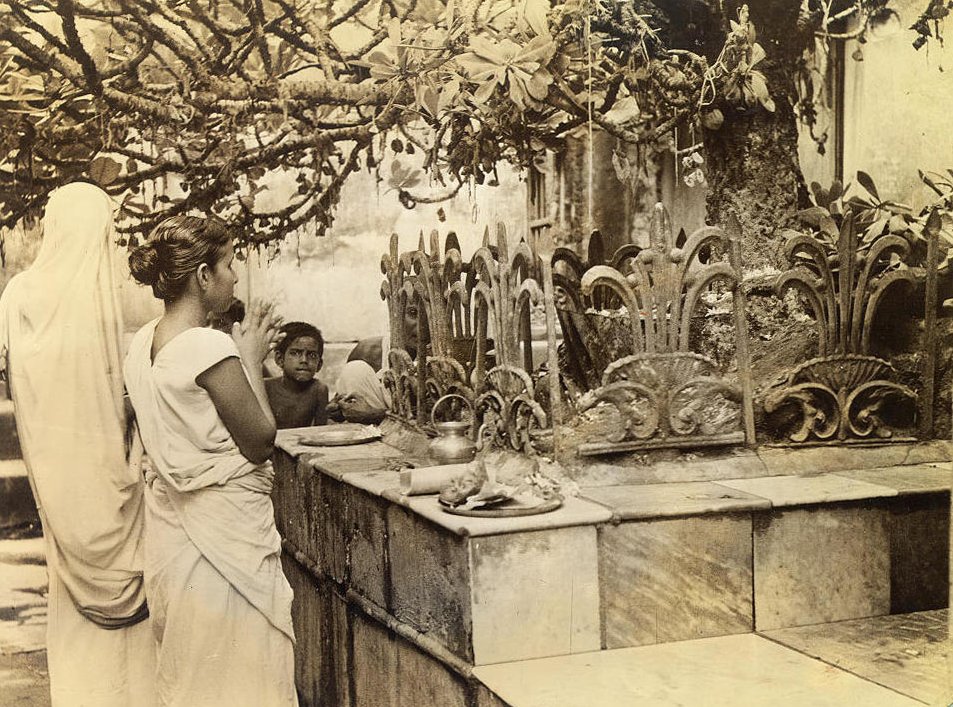
Hindu wife prays to the God Siva Hindu wife prays to the God Siva for blessing of fertility. Phallic symbol is obscured by iron grating at base of a type cactus tree which is believed to have power to endow worshipper with productive powers. Woman whose face barely shows behind tree has prayed in vain for days and has been seen there day after day by Red Cross girls who take GI tours to the temple.

Source : library.upenn.edu

Apr 1, 2015

Calcutta ( Kolkata ) 1945: An American Military Photograph Album - Part 4

Part 1 | Part 2 | Part 3 | Part 4 | Part 5 | Part 6 | Part 7 | Part 8 | Part 9

Kalighat temple
A strong contrast to the splendor of the Jain temple is the Kalighat temple, built in the 1600's, worship place of Hindus. It is famous for the practice of sacrificing goats, as many as 1500 having been slaughtered in one day. On the bank of a canal cut from the original Ganges bed, it is the temple of the Goddess kali.

The Jain templeThe Jain temple, Parashnath Mandir, is Calcutta's gaudiest and most elaborate temple. The Jains are a sect of the Hindus, a great many of whom belong to the money-lending class, are shrewed and frequently wealthy.Jains do not believe in taking a life, often even wear a nostril veil to prevent inhaling of insects.

Native madman Native madman is allowed to roam the streets naked, accosting cars, sitting down in middle of the street or anything else that takes his fancy. How he escapes being run down or run in by the law is one of India's mysteries.

Performer
Belive it or not, this man has just bitten the head from a live Krait snake. He is professor Sher Mohammed and his feats include drinking acid, eating glass, fire-walkig. He is a legitimate performer and has spent the war years touring for the entertainment of Indian troops rather than poach on sidewalk tourists.

 young showmanRagged urchins roam he streets begin GI audiences to let their mangy monkeys dance the 'american Jitterbug' dance. This unfortunate young showman has offended the long arm of the law and is prodded along. The Monk seems to realize the position.

Source : library.upenn.edu

Calcutta ( Kolkata ) 1945: An American Military Photograph Album - Part 3

Part 1 | Part 2 | Part 3 | Part 4 | Part 5 | Part 6 | Part 7 | Part 8 | Part 9

This collection consisting of 60 photographs of Calcutta ( Kolkata ) taken most likely between 1945-1946. The photographer, Mr. Clyde Waddell, also provided the interesting notes accompanying each photograph.

Calcutta Tram 1945Indians are the bravest commuters in the world. They hang from every handhold. The two shown here, however, are bent on clinching a seat before the car fills. Ancient double-decker buses sway and chug under the strain of double overloads and trams make packed neew York subways seem comofortable by comparison.

sikh taxi-driverOf Calcutta's assortment of colorful and intriguing characters, the sikh taxi-driver and his co-pilot rank high. The co-pilot was added in 1944 following an affray in which a soldier knifed a driver. The two GI's shown here are doing their best to convey their destination to the driver of the ancient jalopy.

Crowd gathers round a sidewalk performerCrowd gathers round a sidewalk performer at bus stop while GI's take temporary advantage of an overhead view from steps of a camp bus. This is a good spost for hawkers, beggars, shoe shine boys, showmen to work on the bankroll of the 'rich American soldier'.

A group of GI's A group of GI's take a close look at the snake-wallah's hooded cobra. Both the snake and his master are good specimens. The fangs, of course, have been removed so the reptile can strike at will, scaring no one.

snake charmerThis weird-looking snake charmer is doing his best to coax a balcony audience to toss down enough baksheesh to get his cobra nad mongoose in the mood to stage a fight to the finish. Actually the combatants always seem a bit bored with the act and after a few fierce snorts and lunges, decide it is better to live.

Calcutta ( Kolkata ) 1945: An American Military Photograph Album - Part 2

Part 1 | Part 2 | Part 3 | Part 4 | Part 5 | Part 6 | Part 7 | Part 8 | Part 9

This collection consisting of 60 photographs of Calcutta ( Kolkata )taken most likely between 1945-1946. The photographer, Mr. Clyde Waddell, also provided the interesting notes accompanying each photograph.

buffalo herd's movements
This buffalo herd's movements seem to be guided by whim alone and are typical of the complete indifference to traffic control by man and animal alike. this is Old Court House street, one of Calcutta's busiest. In left background is Great Eastern Hotel, Calcutta's best, used by U.S. Officers as a billet.

Calcutta's traffic
Calcutta's traffic is usually snarled. And the reasons are clearly shown. Shuffling coolies and
padestrians with little regard for their lives seem completely oblivious to the perils of automitive traffic.
the American Red Cross
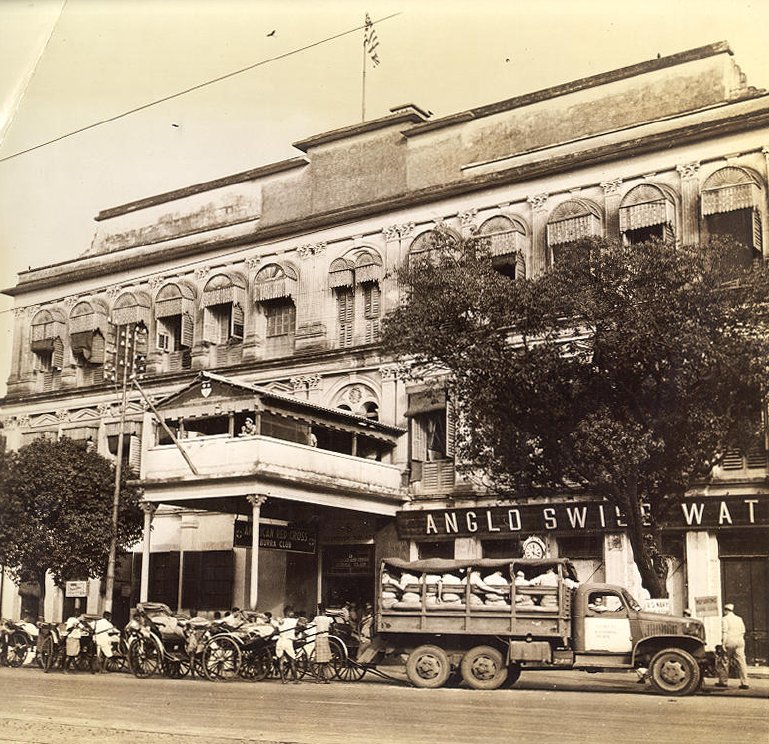
the American Red Cross Burra Club, leave center for GI's and recreation spot for all enlisted men. The unpretentious facade belies an interior complete with dormitory, snack bar, restaurant, music room games room, lounge, barber and tailor shops, wrapping service department and post exchange.

Karnani Estates
Karnani Estates, mammoth apartment hotel for U.S. Army officers. Known to the many thousands of transient and locally based officers as a social center, it has been provided with one of the most elaborately decorated bars of any officers club in the CBI theater.

Chowringhee Square
Chowringhee Square. The Mohammddan mosque, Juma Masjid, is shown at left. This is actually one of the quiet moments when GI trucks, taxis, bicycles and other modes of transport can move with comparative freedom.