Showing posts with label Tomb. Show all posts

Aug 8, 2021

Tomb of a Mahomedan Lady at Booran Sahib's Durgah, Near Hyderabad - c1860s


Photographs from the book: Sketches in India; Taken at Hyderabad and Secunderabad, by Captain Allan N. Scott, Madras Artillery.
Source: British Library

Mahomedan Roadside Tombs near Hyderabad - c1860's


Photographs from the book: Sketches in India; Taken at Hyderabad and Secunderabad, by Captain Allan N. Scott, Madras Artillery.
Source: British Library

Entrance to the Tomb of Boorhan Sahib, Near Hyderabad - c1860s


Photographs from the book: Sketches in India; Taken at Hyderabad and Secunderabad, by Captain Allan N. Scott, Madras Artillery.
Source: British Library

Jan 3, 2016

Bibi Peri's Tomb, Lal Bagh in Dhaka (Currently in Bangladesh) - 1904

Bibi Peri's Tomb, Lal Bagh in Dhaka (Currently in Bangladesh) - 1904

Photograph taken by Fritz Kapp in 1904 of the mausoleum in Lalbagh Fort in Dacca ( Dhaka), part of an album of 30 prints from the Curzon Collection.

Source: bl.uk ( British Library)

Jul 12, 2015

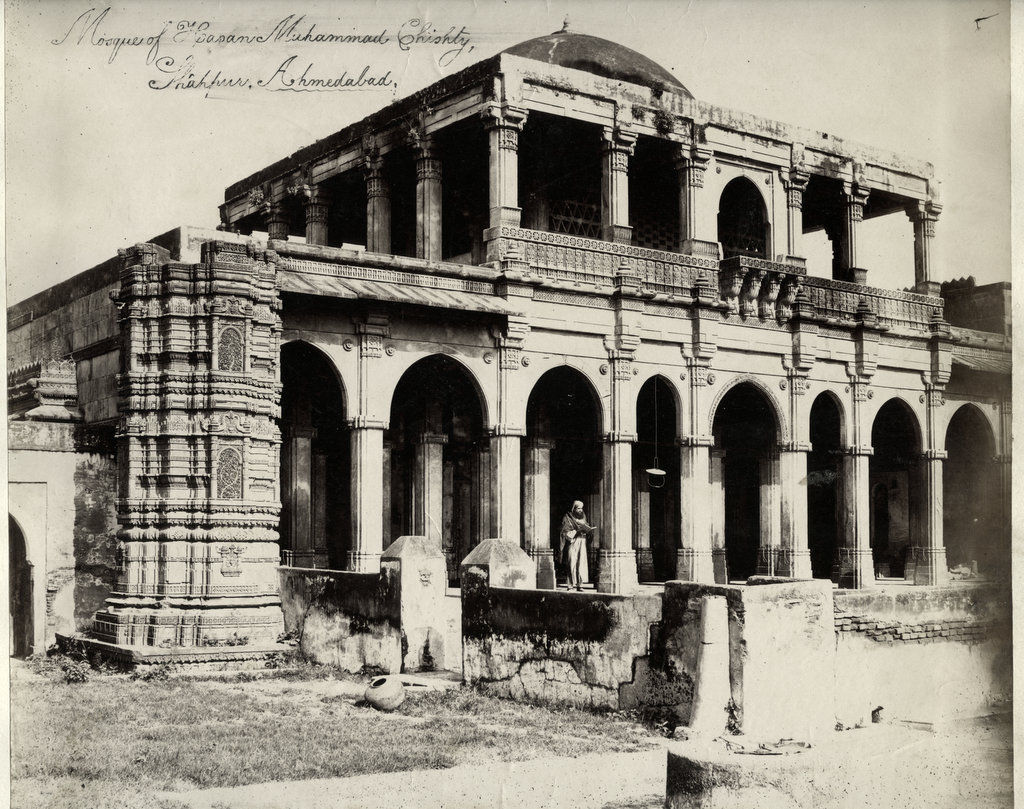
Shaikh Hasan Muhammad Chishti's Tomb (Shahpur Mosque), Shahapur, Ahmadabad, Gujarat - 1860's

Shaikh Hasan Muhammad Chishti's Tomb (Shahpur Mosque), Shahapur, Ahmadabad, Gujarat - 1860's

Credit: James Kerr (pumpparkphotos.com)

Shaikh Hasan Muhammad Chishti's Tomb (Shahpur Mosque), Shahapur, Ahmadabad, Gujarat - 1885

Shaikh Hasan Muhammad Chishti's Tomb, Shahapur, Ahmadabad, Gujarat - 1885

Photograph of Shaikh Hasan Muhammad Chishti's Mosque at Shahapur in Ahmadabad in Gujarat, taken by Henry Cousens in the 1880s, from the Archaeological Survey of India. This mosque was built in 1565 in the Shahapur district, close to Shahapur Gate and the river. The pillars of the facade support nine cusped arches. Over the central five arches is a second storey, supporting a dome. The minarets, with their exuberant carving, particularly that in the niches, are among the most elaborate in Gujarat.
Know more about this architecture in Wikipedia
 
Source: British Library

Jun 3, 2015

Nizamuddin Dargah, Delhi, India - 1890s

Nizamuddin Dargah is the dargah (mausoleum) of famous Sufi saint Nizamuddin Auliya. Situated in the Nizamuddin West area of Delhi.

Know More about this beautiful architecture in wikipedia

Nizamuddin Dargah, Delhi, India - 1890s

Source: 19cphoto.com
Contributor: Anthony Davis (antiqphoto@earthlink.net)

Nov 5, 2014

Oct 19, 2014

Tomb of Akbar the Great in Sikandra, a Suburb of Agra, Uttar Pradesh - c1860's

Gateway of Tomb of Akbar
 Gateway of Akbar's Tomb

Gateway of Tomb of Akbar
 Gateway of Akbar's Tomb

Tomb of Akbar
 Tomb of Akbar

Tomb of Akbar
 Tomb of Akbar

Tomb of Akbar
Tomb of Akbar

View a modern photograph
Modern photo of gateway

Photographer: Felice Beato and Henry Hering
Digital image courtesy of the Getty's Open Content Program.

Oct 13, 2014

Humayun's tomb in the background and the Barber's Tomb (Nai-ka-Gumbad c.1590) on the right - Delhi 1858

Humayun's tomb and Barber's tomb

Towards the south-east corner, within the 'char bagh' garden, lies a tomb known as Nai-ka-Gumbad, or Barber's Tomb, belonging to royal barber, it is datable to 1590-91 CE, through an inscription found inside. Its proximity to the main tomb and the fact that it is the only other structure within the main tomb complex suggests its importance, however there are no inscriptions suggesting as to who is interred therein, the name Barbers tomb is the local name of the structure, hence still in use. (Wikipedia)

Source:  British Library

Humayun's Tomb (Humayun ka Maqbara) - Delhi 1858


Humayun's tomb (Humayun ka Maqbara) is the tomb of the Mughal Emperor Humayun in Delhi, India. The tomb was commissioned by Humayun's first wife Bega Begum (Haji Begum) in 1569-70, and designed by Mirak Mirza Ghiyas, a Persian architect chosen by Bega Begum. It was the first garden-tomb on the Indian subcontinent, and is located in Nizamuddin East, Delhi, India, close to the Dina-panah citadel also known as Purana Qila (Old Fort), that Humayun founded in 1533. It was also the first structure to use red sandstone at such a scale. The tomb was declared a UNESCO World Heritage Site in 1993
Know more in Wikipedia

Source: British Library

Jul 20, 2014

Mar 19, 2014

Feb 28, 2014

Tomb of Safdarjung - New Delhi 1938


Source: Ebay Seller periodpaper

Safdarjung's Tomb is a sandstone and marble mausoleum in New Delhi, India. It was built in 1754 in the late Mughal Empire style for the statesman Safdarjung, and was described as the last flicker in the lamp of Mughal architecture.
Know more in Wikipedia

Jun 15, 2013

Tomb of Zinat Algiya - Lucknow 1860's


Source: National Gallery of Canada

Jun 12, 2013

Moorshud (Khurshid) Zadi's Tomb - Lucknow 1870's


Commisioned by Nawab Ghazi-ud-din Haider (r.1814-1827), this tomb was for the wife of the previous Nawab of Awadh Saadat Ali Khan (r.1798-1814). Split into four levels, the tomb of Khurshid Zadi can be found in a center room in the basement.

From the book

The Lucknow album : containing a series of fifty photographic views of Lucknow and its environs together with a large sized plan of the city (1874)
Read the full book

Jun 9, 2013

Saadut Ali Khan's Tomb - Lucknow 1870's


A recent photograph of the tomb

From the book
The Lucknow album : containing a series of fifty photographic views of Lucknow and its environs together with a large sized plan of the city (1874)
Read the full book

Mar 2, 2013

Chausath Khamba in Delhi - Late 19th Century


Chausath Khamba, also spelled Chaunsath Khamba  is a tomb built during 1623–24. It is located in Nizamuddin precincts (a heritage zone) of Sufi Muslim shrines and tombs in New Delhi, India. The name means "64 pillars" in Urdu and Hindi. It was built by Mirza Aziz Koka, son of Ataga Khan, as a mausoleum for himself, at the time when Mughal Emperor Jahangir ruled from Delhi. Mirza Aziz Koka had served several times as Jahangir’s Governor of Gujarat before his died in Gujarat. Ataga Khan was prime minister of Emperor Akbar.
Know more about this architecture in Wikipedia

Credit: James Kerr ( pumpparkphotos.com )

Tomb of Ranjit Singh in Lahore - c1880's


The Samadhi of Ranjit Singh is the mausoleum of the Sikh ruler Maharaja Ranjit Singh (1780 - 1839). It is located near the Lahore Fort and Badshahi Mosque in Lahore, Pakistan. Construction was started by his son, Kharak Singh on the spot where he was cremated, and was completed by his youngest son, Duleep Singh in 1848.
Know more about this architecture in Wikipedia

Credit: James Kerr ( pumpparkphotos.com )

Sep 7, 2012

Vintage Photograph of Taj Mahal in Agra - c1880's


Source: ebay.com